
The Smallest Voices, the Deepest Memories: An Interview with the Creator of 'Milo', Venkatesh Balasubramanian
What was the core inspiration for Milo, particularly the blend of whimsical insect protagonist with deeply emotional human family themes? How did the story concept evolve from initial idea to final script?
The original spark came from my wife during a trip. One night she woke up and said, "Mosquitoes are singing in my ears." She meant they were buzzing, but that accidental phrasing immediately fascinated me.
I couldn't stop thinking about the idea of a mosquito singing instead of buzzing. It completely flipped the way I viewed something we instinctively find annoying. I began asking myself: what if a mosquito was genuinely trying to create something beautiful?
That question became the foundation of Milo. He emerged as a young artist whose survival depends on being heard. As the story evolved, the grandmother became his emotional counterpart, someone carrying memories of a lost love and a life well lived. Once those emotional journeys intersected, the story stopped being just about a mosquito and became a story about memory, loss that ultimately leading to a heartbreaking finale.
The film features a very intimate scale, a tiny fly interacting with a human ear and an elderly woman.

How did you approach the visual and spatial challenges of contrasting microscopic and human-scale worlds in animation?
The contrast between scales became one of the film's primary storytelling tools.
For Milo, a human apartment feels enormous. Lamps become towering monuments. Books become walls. A human hand moving toward him feels like an incoming natural disaster. I wanted audiences to constantly feel the vulnerability of his perspective. Conversely, when we shift into the grandmother's emotional experience, the camera becomes calmer and more intimate. The apartment shrinks emotionally into a space of loneliness and memory.
Rather than treating scale as a technical challenge, we treated it as an emotional one. The environment expands or contracts depending on whose emotional reality we're inhabiting.
Milo's character design (goggles, scarf, expressive face) is highly anthropomorphic yet retains insect qualities. What references or principles guided his design, and how did you balance cuteness with vulnerability?
The challenge was making audiences empathize with a creature most people instinctively dislike. I had leaned into classic animation principles where silhouette and expressiveness communicate personality before realism. The goggles and scarf immediately suggest a dreamer, an adventurer, and a student. They also help separate Milo from a real mosquito and place him firmly in the realm of character.
At the same time, I wanted him to remain physically fragile. His thin wings, tiny body, and constant exposure to danger remind viewers that despite his optimism, he exists in a world where one mistake can end everything. That tension between courage and vulnerability became central to his appeal.

The grandmother character carries significant emotional weight. How did you develop her personality and visual design to make her feel both universal and deeply personal?
The grandmother represents a very universal experience: living with memories after losing someone you love. I intentionally avoided giving her an overly specific backstory on screen. Instead, I focused on recognizable details: the solitary apartment, the reading lamp, the photo album, and the quiet routines. Her design emphasizes warmth and humanity rather than sadness. I wanted audiences to feel that she had lived a full life and carried decades of love with her.
The goal was for viewers to project their own grandparents, parents, or loved ones onto her. The more personal she felt to each audience member, the more powerful the emotional climax became.
The film uses a "limited attempts" mechanic. How did you use this video-game-like structure to build tension and emotional stakes in a short film format?
The attempts mechanic gave the story a visible countdown. Short films often struggle to create escalating stakes quickly. By showing Milo's remaining attempts, audiences immediately understand that failure has consequences. Initially, the mechanic functions almost comedically as Milo repeatedly gets swatted, chased, and humiliated. But as the number decreases, the same device gradually becomes dramatic.
By the final attempt, viewers aren't thinking about a game mechanic anymore. They're thinking about a frightened young artist facing his last chance. The structure creates urgency while also reflecting the pressure many creatives feel when everything seems to depend on a single opportunity.
Sound design and music appear central. The idea of "buzzing a complete song" in an ear is both literal and metaphorical. How did you approach the sound mix, especially the integration of diegetic buzzing with the emotional score?
Sound is essentially the film's language. Milo cannot communicate through words with the grandmother, so music becomes the bridge between their worlds. His buzz begins as an annoying, familiar sound but gradually transforms into something melodic and emotionally meaningful.
We imagined the score evolving alongside the audience's perception of him. Early on, the buzzing feels disruptive. As viewers grow attached to Milo and learn the significance of the melody, the same sound becomes beautiful. The climax required the buzzing and orchestral score to blend together, reinforcing the idea that memory itself is singing through the room.
The film moves fluidly between humor, tension, and heartfelt moments. How did you calibrate the tone to prevent the comedy from undermining the emotional climax?
The comedy always comes from Milo's situation rather than from the grandmother's loneliness. The repeated swatting attempts create entertainment while also establishing genuine danger. Every laugh serves a storytelling purpose.
As the film progresses, the comedy naturally gives way to vulnerability. By the time the lullaby begins, the audience has already bonded with Milo, allowing the film to become more sincere without feeling manipulative. The emotional climax works because viewers first connect with the character through humor. The laughs create affection, which makes the heartbreak land much harder.
There are touching flashbacks or memory elements involving family photographs and younger characters. How did you weave the theme of legacy, memory, and generational connection into the narrative?
The film is ultimately about how people continue to exist inside the memories of others. The flashbacks are intentionally brief and impressionistic. They're less about explaining history and more about recreating the feeling of remembering someone you miss. The photo album serves as a physical manifestation of memory, while the lullaby becomes an emotional one. What fascinated me was the idea that something as small and seemingly insignificant as a mosquito could unexpectedly reconnect someone with one of the most meaningful relationships of their life.
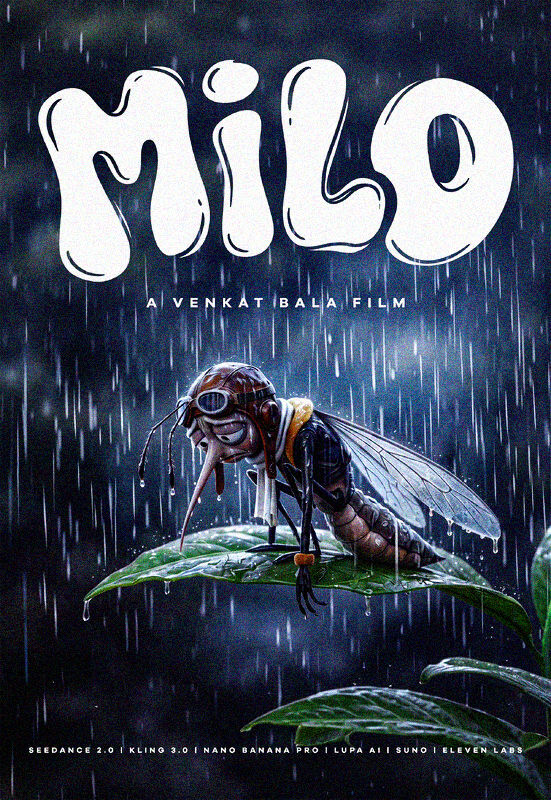
As an AI-assisted or AI-generated film, what were the biggest creative opportunities and technical challenges you faced during production? What aspects remained fully under traditional directorial control?
AI gave me the ability to rapidly explore visual ideas, character designs, environments, and storytelling possibilities in ways that would have been difficult with a traditional pipeline.
The challenge was consistency. Emotional storytelling depends on performance, pacing, continuity, and intentional visual language. Those aspects still required careful creative direction and refinement. The story, character arcs, emotional beats, editing decisions, and thematic intent remained entirely humandriven. AI was a creative tool, but the heart of the film came from the choices made during writing and directing.
The final sequences, particularly the moment Milo is held in the grandmother's hands, are visually and emotionally powerful. How did you direct and refine that climactic payoff?
The ending was built around the idea that triumph and tragedy could exist in the same moment. Throughout the film, audiences expect Milo to be swatted. The surprise isn't what happens, but when it happens. Milo succeeds. He passes his exam and experiences the happiest moment of his life. Only then does instinct take over.
What interested me most was the grandmother's reaction. The melody reconnects her with memories of her late husband, but the moment she notices the mosquito, instinct takes over. She swats him and feels a brief sense of victory, having been troubled by his buzzing for so long.
What she doesn't realize is that the tiny creature she has been trying to kill was the very source of that precious memory.
If you had to define the central theme or message of Milo in one sentence for the audience, what would it be? How consciously did you embed that theme throughout the film's visual language and structure?
The smallest voices can awaken the memories that matter most. That idea guided every major creative decision. Milo is physically tiny but emotionally transformative. The lullaby is almost insignificant in scale, yet powerful enough to reconnect someone with a lifetime of love. Throughout the film, we continually contrast small actions with profound emotional consequences. The story suggests that meaningful impact isn't measured by size, power, or permanence, but by the memories we leave behind.

Looking back at Milo, is there any directorial choice (in storytelling, animation style, or pacing) you would approach differently now, and what advice would you give to other filmmakers working on emotionally driven short animations?
One lesson I took away is that audiences are often more willing to embrace sincerity than filmmakers assume. Earlier versions spent more time explaining mechanics and worldbuilding. The strongest version emerged when we trusted emotion to do more of the heavy lifting.
My advice to filmmakers would be to identify the single emotional truth at the center of your story and protect it relentlessly. In a short film, every scene, every shot, and every line should serve that core feeling. If audiences leave remembering how the film made them feel rather than how it worked, you've probably done your job.


Comments